
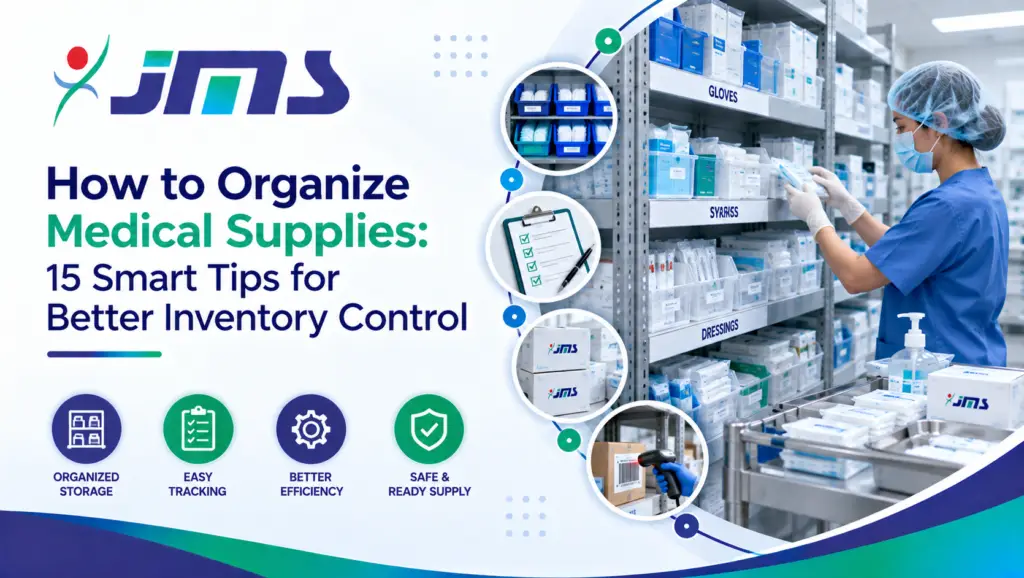
Healthcare facilities manage a large variety of medical supplies every day. Hospitals, clinics, nursing homes, diagnostic centres, surgical facilities, and other healthcare organizations may need to maintain inventory ranging from gloves, gauze, cotton, dressings, and medical tapes to orthopedic products, medical devices, and other essential supplies.
When these products are not properly organized, staff may spend more time searching for supplies, stock levels can become difficult to monitor, and products approaching expiry may be overlooked.
A structured medical supply organization system can make inventory easier to access, monitor, replenish, and manage.
The most useful approach is to organize supplies based on several factors, including product category, usage frequency, department, stock level, expiry requirements, and storage needs.
Why Is Proper Medical Supply Organization Important?
A well-organized medical inventory can help healthcare facilities:
- Locate supplies more quickly
- Maintain appropriate stock levels
- Reduce unnecessary wastage
- Monitor expiry dates
- Improve stock rotation
- Reduce duplicate purchasing
- Support efficient department operations
- Protect products from unsuitable storage conditions
- Improve inventory visibility
Good organization is especially important when a facility manages hundreds or thousands of individual products.
1. Organize Medical Supplies by Product Category
The first step is to group products according to their type and general function.
For example, a healthcare facility could create separate storage sections for:
Medical Gloves
Different glove types and sizes can be organized together while keeping individual sizes clearly identified.
Cotton Products
Absorbent cotton, cotton rolls, cotton balls, dental cotton rolls, and other cotton products can be separated according to their specifications.
Gauze and Dressings
Gauze swabs, gauze rolls, pads, dressings, and other wound-care products can be grouped together.
Medical Tapes
Surgical tapes, adhesive products, and related items can have their own designated section.
Orthopedic Products
Casting materials, padding, bandages, and other orthopedic supplies can be organized separately.
Medical Devices and Equipment
Products such as nebulizer-related equipment, BP products, O2-related products, and other medical devices should be stored according to their specific requirements.
Why this helps: Category-based organization makes products easier to locate and reduces confusion between similar-looking items.
2. Organize Supplies by Usage Frequency
Not every medical supply is used at the same rate.
Some products may be used hundreds of times a week, while others may only be required occasionally.
A practical inventory system can classify products into:
High-Use Products
Examples may include:
- Examination gloves
- Gauze
- Cotton
- Common dressings
- Frequently used medical tapes
These products should be placed in easily accessible locations.
Medium-Use Products
These may be needed regularly but less frequently than everyday consumables.
They can be stored in nearby but less prominent locations.
Low-Use Products
Specialized or occasionally required products can be stored in designated areas without taking up prime-access space.
Why Usage Frequency Matters
Placing frequently used supplies closer to the point of use can:
- Reduce staff walking time
- Make replenishment easier
- Improve workflow
- Reduce unnecessary handling
- Make shortages easier to identify
The exact placement should always take into account the product’s required storage conditions.
3. Organize Medical Supplies by Department
Large healthcare facilities often have multiple departments with different supply requirements.
For example:
- Emergency Department
- Operation Theatre
- Outpatient Department
- Intensive Care Unit
- Laboratory
- Dental Department
- Orthopedic Department
- Dressing/Wound-Care Area
- General Ward
Supplies can be allocated or organized according to departmental requirements.
Example
An orthopedic department may regularly require specific orthopedic products, while a dressing area may require larger quantities of gauze, cotton, and dressings.
The facility can maintain:
Central Inventory → Departmental Stock → Point-of-Use Stock
This structure can help the central procurement team maintain overall visibility while allowing individual departments to access frequently needed products.
4. Create Clearly Defined Storage Locations
Every product should ideally have a designated storage location.
A storage-location system can include:
Room → Rack → Shelf → Product → Size/Specification
For example:
Medical Store → Rack A → Shelf 2 → Examination Gloves → Medium
This makes it easier for staff to locate products and return them to the correct place after receiving or issuing stock.
Clear shelf labels can include:
- Product name
- Size
- Specification
- Stock code
- Storage requirements where relevant
5. Organize by Stock Level
Healthcare facilities should maintain enough stock to support normal operations without unnecessarily overstocking products.
A simple stock-level system can classify inventory into:
Minimum Stock Level
The minimum quantity that should generally be maintained before replenishment is required.
Reorder Level
The point at which a new purchase order should be considered, taking into account usage and supplier lead time.
Maximum Stock Level
The quantity above which additional stock may create unnecessary storage pressure, expiry risk, or excess inventory.
These levels should be established based on actual usage patterns, supplier lead times, storage capacity, and the criticality of the product.
6. Use Stock Rotation for Expiry Management
Expiry monitoring is particularly important for healthcare products that have a defined shelf life.
A useful approach is FEFO — First Expiry, First Out.
Under FEFO, products with the earliest expiry dates are prioritized for use or issue before products with later expiry dates.
Example
Suppose a healthcare facility has two batches of the same product:
Batch A → Expires in March
Batch B → Expires in August
Batch A should generally be prioritized for use, provided it remains suitable for use.
Why FEFO Helps
FEFO can help:
- Reduce expiry-related wastage
- Improve stock rotation
- Identify products approaching expiry
- Improve inventory control
7. Separate Products According to Storage Requirements
Not all medical supplies should necessarily be stored under identical conditions.
Some products may require particular environmental conditions according to manufacturer instructions.
Storage areas can therefore be organized according to requirements such as:
- General room-temperature storage
- Products requiring protection from moisture
- Products requiring protection from light
- Products requiring specific temperature conditions
- Products requiring special handling
- Products requiring controlled or restricted storage
Important: Healthcare facilities should always follow the specific manufacturer’s storage instructions and applicable requirements. Do not assign a generic temperature range to a product without checking its labeling or documentation.
8. Protect Packaging During Storage
Medical products should be protected from physical and environmental damage.
Storage staff should regularly check for:
- Torn packaging
- Broken seals
- Punctures
- Moisture damage
- Crushed cartons
- Unclear labels
- Signs of contamination
Where appropriate, products should remain in their original packaging until required for use.
Products should also be stored in a way that prevents unnecessary crushing or pressure.
9. Keep Frequently Used Supplies Easy to Access
High-use products should generally be positioned where authorized staff can access them efficiently.
For example, frequently used gloves, gauze, cotton, and dressing products may be placed in convenient locations.
However, accessibility should not compromise:
- Product security
- Cleanliness
- Storage requirements
- Stock rotation
- Infection-control procedures
The goal is to create a balance between easy access and appropriate storage.
10. Keep Similar Products Clearly Separated
Some medical supplies can have similar packaging or names but different specifications.
For example, gloves may differ by:
- Size
- Material
- Intended application
- Packaging quantity
Similarly, gauze may differ by:
- Size
- Layers
- Construction
- Sterility
- Packaging format
Clearly separating these products can help reduce selection errors.
Labels should be easy to read and should identify the most important product characteristics.
11. Maintain a Medical Inventory Record
A good organization system should be supported by accurate inventory records.
A basic inventory record can include:
| Information | Purpose |
|---|---|
| Product Name | Identifies the item |
| Product Category | Supports organization |
| Size/Specification | Prevents confusion |
| Quantity | Shows current stock |
| Batch/Lot Number | Supports traceability |
| Expiry Date | Supports expiry monitoring |
| Storage Location | Makes products easier to find |
| Minimum Stock | Supports replenishment |
| Reorder Level | Indicates when purchasing may be needed |
| Supplier | Supports procurement |
Digital inventory systems can make this process easier, particularly for larger healthcare organizations.
12. Organize Stock According to Departmental Demand
Different departments may consume different products at different rates.
For example:
Emergency Department
May require quick access to frequently used general medical consumables.
Operation Theatre
May have specific requirements for surgical and procedure-related supplies.
Orthopedic Department
May have greater demand for orthopedic products, dressings, and related materials.
Dental Department
May regularly use dental cotton rolls and other dental-specific consumables.
General Wards
May require ongoing supplies such as gloves, gauze, cotton, dressings, and tapes.
Understanding departmental demand helps healthcare facilities allocate inventory more effectively.
13. Monitor Critical and Essential Supplies
Some products may be more operationally critical than others.
Healthcare facilities can identify products where stockouts could significantly disrupt routine operations.
These products may receive:
- More frequent stock checks
- Higher-priority replenishment
- Clearly defined minimum stock levels
- Dedicated storage locations
- Closer monitoring of supplier lead times
The facility should determine which products are critical based on its own clinical and operational requirements.
14. Avoid Overstocking
Having too much inventory can be just as problematic as having too little.
Excess inventory can:
- Occupy valuable storage space
- Increase expiry risk
- Increase handling requirements
- Tie up purchasing budgets
- Make stock rotation more difficult
Stock levels should therefore be based on actual consumption patterns, expected demand, supplier lead times, and product shelf life.
15. Conduct Regular Inventory Audits
A storage system should be reviewed periodically.
During an inventory audit, staff can check:
Product quantity
Expiry dates
Packaging condition
Storage conditions
Batch/lot information
Product location
Stock discrepancies
Products approaching expiry
Regular audits can identify problems before they become significant.
A Practical Medical Supply Organization System
Healthcare facilities can combine all the above factors into one structured system.
For example:
Step 1: Categorize
Gloves → Cotton → Gauze → Tapes → Orthopedic → Devices
Step 2: Identify Usage
High Use → Medium Use → Low Use
Step 3: Assign Department
Emergency → OT → OPD → ICU → Laboratory → Orthopedic → Dental
Step 4: Define Stock Levels
Minimum → Reorder → Maximum
Step 5: Apply Expiry Management
FEFO → Regular Expiry Checks
Step 6: Assign Storage Conditions
General → Moisture Protection → Light Protection → Specific Manufacturer Conditions
This creates a system where every product has a defined category, location, usage priority, stock level, expiry status, and storage requirement.
Example of an Organized Medical Inventory
| Product | Category | Usage | Department | Stock Priority | Expiry Management | Storage |
|---|---|---|---|---|---|---|
| Examination Gloves | Gloves | High | OPD/Emergency | High | FEFO | Clean, dry area |
| Gauze Swabs | Gauze | High | Dressing/OT | High | FEFO | Protect packaging |
| Absorbent Cotton | Cotton | High | General/Wards | High | Shelf-life monitoring | Dry area |
| Medical Tape | Tapes | Medium | Wards/OT | Medium | FEFO where applicable | Manufacturer instructions |
| Orthopedic Casting Material | Orthopedic | Medium/Low | Orthopedic | Based on demand | FEFO where applicable | Product-specific |
| Dental Cotton Rolls | Dental | Medium | Dental | Based on demand | Shelf-life monitoring | Clean, dry area |
| Medical Device | Medical Device | Variable | Relevant department | Based on need | Product-specific | Manufacturer instructions |
This is an illustrative organization model. Actual stock levels and storage conditions should be established according to the healthcare facility’s requirements and each product’s manufacturer instructions.
Best Practices for Maintaining an Organized Medical Store
A well-managed medical store can follow a simple routine:
Daily
- Return products to designated locations.
- Keep frequently used areas organized.
- Check for obvious packaging damage.
- Maintain cleanliness.
Weekly
- Review frequently used products.
- Check stock levels.
- Identify products approaching reorder levels.
- Inspect storage conditions.
Monthly
- Review expiry dates.
- Conduct inventory reconciliation.
- Identify slow-moving products.
- Review excess stock.
- Check storage organization.
Periodically
- Conduct a complete inventory audit.
- Review supplier performance.
- Update stock levels based on consumption.
- Review storage requirements.
- Remove or manage expired and compromised products according to facility procedures.
Role of a Reliable Medical Supplier
Good inventory organization also depends on reliable procurement.
A dependable medical manufacturer or supplier can support healthcare facilities through consistent product specifications, predictable supply, appropriate packaging, product documentation, and timely communication.
For healthcare buyers, supplier selection should therefore consider more than purchase price.
Important factors can include:
- Product quality
- Consistency
- Product range
- Packaging
- Documentation
- Supply capacity
- Delivery reliability
- Customer support
A reliable supply partner can make it easier for healthcare facilities to maintain appropriate inventory levels and plan recurring purchases.
JMS Medicon: Supporting Healthcare Supply Requirements
JMS Medicon provides a range of healthcare and medical products, including medical gloves, cotton products, gauze products, tapes and orthopedic products, nebulizer/BP/O2 products, and surgical and medical devices.
For healthcare organizations managing multiple product categories, having access to a broad range of medical supplies can support more streamlined procurement.
However, every product should still be managed according to its individual specifications, manufacturer instructions, storage requirements, and applicable healthcare-facility procedures.
Medical Supply Organization Checklist
Healthcare facilities can use this checklist when reviewing their storage system:
✓ Products grouped by category
✓ High-use products easily accessible
✓ Department-specific requirements identified
✓ Each product has a designated storage location
✓ Minimum and reorder levels established
✓ FEFO used for applicable products
✓ Expiry dates checked regularly
✓ Storage conditions matched to manufacturer instructions
✓ Packaging protected from damage
✓ Similar products clearly separated
✓ Batch/lot information maintained where applicable
✓ Inventory records updated
✓ Critical supplies monitored more closely
✓ Overstocking reviewed
✓ Regular inventory audits conducted
Conclusion
Organizing medical supplies effectively requires more than simply placing products on shelves. Healthcare facilities can create a more efficient inventory system by organizing supplies according to product category, usage frequency, department, stock level, expiry requirements, and storage needs.
A structured approach makes it easier to locate supplies, monitor inventory, rotate stock, protect products, identify upcoming shortages, and manage expiry dates.
Whether the facility is managing gloves, cotton, gauze, medical tapes, orthopedic products, or medical devices, each product should have a clearly defined place and appropriate storage conditions.
Combined with accurate inventory records and a dependable medical supplier, good organization can help healthcare facilities maintain a more reliable and efficient supply system.
Looking for Reliable Medical Supplies?
JMS Medicon Private Limited
Email: jmsmedicon@gmail.com
Phone: +91 9437040988
Office Address:
Plot No-85, Padmalava Nagar, Trisulia, Cuttack, Odisha – 754005
Registered Address:
H-1370 DSIDC Industrial Complex, Narela, Delhi – 110040
Website: www.jmsmedicon.com
