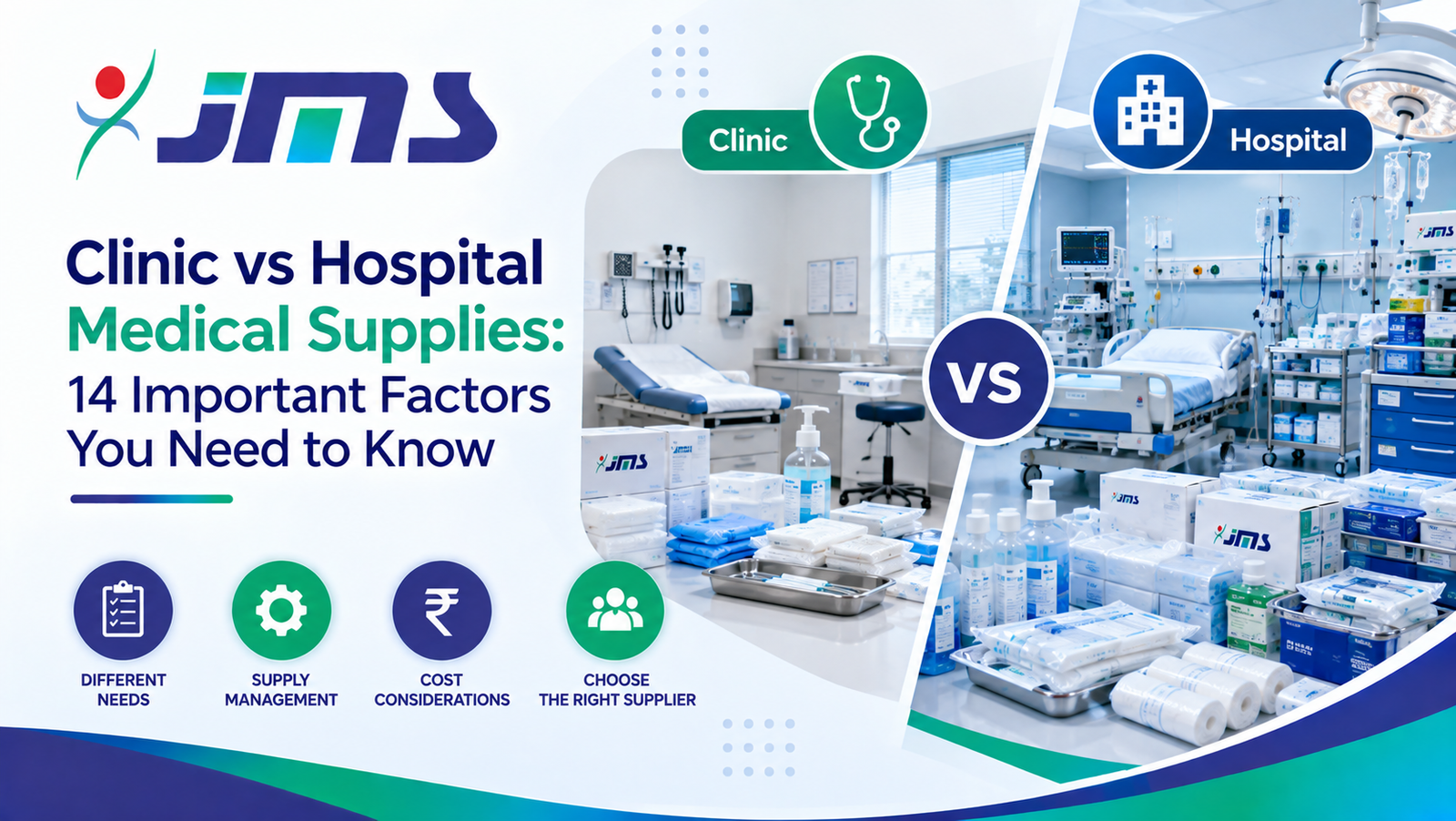
Clinic vs Hospital Medical Supplies: 14 Important Factors You Need to Know
Healthcare facilities depend on a steady supply of medical products to support patient care and daily operations. However, the supply requirements of a small clinic can be very different from those of a large hospital. A clinic may manage a relatively focused range of medical consumables for routine consultations and procedures, while a hospital may require a much broader inventory covering multiple departments, specialties, procedures, and patient-care needs. Understanding these differences can help healthcare procurement teams choose appropriate products, plan inventory levels, organize storage, and establish suitable purchasing schedules. This guide compares the general supply requirements of clinics and hospitals across product variety, quantity, storage, purchasing frequency, and operational needs. Clinic vs Hospital: An Overview The main difference is generally the scale and complexity of operations. A clinic may serve a smaller patient population and focus on specific outpatient services. A hospital can operate multiple departments and may provide outpatient, inpatient, emergency, surgical, diagnostic, and specialized care. This difference influences almost every part of medical supply management. Factor Clinic Hospital Product Variety Usually more focused Broad and highly diverse Quantity Lower overall volume Higher volume Storage Smaller storage areas Larger and often department-specific Purchasing Often periodic and demand-based More frequent and structured Departments Fewer Multiple departments Inventory Management Relatively simple More complex Stock Monitoring Often centralized Central + departmental Operational Needs Primarily routine/outpatient Continuous and multi-departmental These are general patterns. Actual requirements vary according to facility size, specialty, patient volume, services offered, and local procurement practices. 1. Product Variety Medical Supply Requirements in Clinics Clinics often have a more focused product portfolio because their services may be limited to particular specialties or routine outpatient care. Common supplies may include: Medical gloves Cotton products Gauze Wound dressings Medical tapes Syringes and other procedure-related supplies Basic diagnostic products Cleaning and hygiene supplies Specialty-specific products For example, a dental clinic may have greater demand for dental-specific consumables, while an orthopedic clinic may require more orthopedic-related products. Why Product Variety May Be More Focused A clinic usually has fewer departments and may perform a narrower range of procedures. As a result, procurement teams can often concentrate on a smaller number of product categories. Hospital Medical Supply Requirements Hospitals generally require a much broader range of medical products. A hospital may need supplies for: Emergency care Operation theatres Intensive care Outpatient departments General wards Laboratories Radiology Orthopedics Dental services Surgical departments Specialty departments Other clinical and support services This creates a much more complex procurement environment. Why Hospitals Need Greater Variety Different departments have different clinical and operational requirements. A hospital may therefore need to maintain multiple sizes, specifications, packaging formats, and product types within the same broad category. 2. Quantity Requirements Clinics Clinics generally have lower overall consumption compared with larger hospitals, although this depends heavily on patient volume. Frequently used products may include: Examination gloves Cotton Gauze Dressings Medical tapes Department-specific consumables Stock quantities can be planned around average patient visits, procedures, supplier lead time, and expected demand. Clinic Inventory Approach A clinic can establish: Minimum Stock → Reorder Level → Maximum Stock This can help avoid both shortages and unnecessary overstocking. Hospitals Hospitals may consume significantly larger quantities because they support more patients, departments, procedures, and shifts. For example, products such as gloves, gauze, cotton, dressings, and other consumables may be required continuously across multiple departments. Hospitals may therefore require: Larger inventory volumes Department-level stock Central medical stores Emergency reserves for selected products More frequent inventory monitoring Hospital Inventory Approach A common structure can be: Central Medical Store → Department Store → Point-of-Use Stock This allows the hospital to maintain centralized visibility while providing departments with access to essential supplies. 3. Storage Requirements Clinics Clinics may operate with smaller storage areas. Because the product range is often more focused, supplies can potentially be organized using: Clearly labelled shelves Product categories Dedicated cabinets Separate sections for frequently used items Expiry-based stock rotation Even in a small clinic, storage conditions should follow manufacturer instructions. Products should generally be protected from unnecessary exposure to moisture, contamination, excessive heat, direct sunlight where applicable, and physical damage. Hospitals Hospitals often need more sophisticated storage arrangements. A hospital medical store may need to manage: Large quantities of inventory Multiple product categories Department-specific supplies Different storage requirements Products with different shelf lives Large cartons and bulk packaging High-use and low-use inventory Hospitals may therefore use separate storage zones and more detailed inventory systems. Department-Based Storage Supplies can be allocated according to departments such as: Emergency → OT → ICU → OPD → Wards → Laboratory → Orthopedic → Dental However, the exact arrangement should be determined by the hospital’s operational and storage requirements. 4. Purchasing Frequency Clinics Clinics may purchase medical supplies periodically based on: Patient volume Average consumption Product shelf life Available storage Supplier lead time Upcoming procedures A small clinic may purchase commonly used supplies more frequently in smaller quantities rather than maintaining large inventories. For products with longer shelf lives and predictable demand, larger purchases may sometimes be practical if adequate storage is available. Hospitals Hospitals typically have more complex purchasing schedules. Because consumption can be high and continuous, procurement teams may use: Regular purchase cycles Scheduled replenishment Department-level demand forecasts Framework or recurring supplier arrangements Emergency procurement procedures for critical shortages Large hospitals may also use inventory-management software to monitor stock levels and automate or support replenishment decisions. 5. Operational Needs Clinics Clinic operations may be centered primarily around outpatient consultations and procedures. Therefore, supplies need to be: Easily accessible Simple to organize Available for routine procedures Appropriate for the clinic’s specialty Easy to replenish A clinic may benefit from keeping high-use products close to the areas where they are regularly used. Hospitals Hospital operations can continue around the clock, depending on the facility. This creates additional supply-management requirements. Hospitals may need to ensure that critical supplies are available across: Multiple shifts Multiple departments Emergency services Surgical procedures Inpatient care Outpatient services Stockouts can potentially have a greater operational impact when multiple departments depend
Clinic vs Hospital Medical Supplies: 14 Important Factors You Need to Know Read More »