

Healthcare Inventory Management

Medical Supply Inventory

Medical Supply Inventory Management: How to Control Stock Better

Healthcare facilities rely on a continuous supply of medical consumables and healthcare products to support daily operations. Hospitals, clinics, nursing homes, diagnostic centres, surgical facilities, and other healthcare organizations may regularly use products such as gloves, cotton, gauze, dressings, medical tapes, orthopedic supplies, and medical devices. Managing these products effectively requires more than simply keeping large quantities in storage. Healthcare facilities need to understand how much stock they use, where products should be stored, when inventory needs to be replenished, which products should be used first, and how to avoid unnecessary overstocking. A structured inventory-management system can help healthcare organizations maintain product availability while reducing avoidable wastage and storage pressure. Why Medical Supply Inventory Management Matters Poor inventory management can create two opposite problems. Too Little Stock Insufficient inventory can lead to: Stockouts Emergency purchasing Delayed procurement Increased operational pressure Difficulty supporting routine requirements Too Much Stock Excess inventory can lead to: Increased storage requirements Products approaching expiry Expiry-related wastage Capital tied up in unused inventory More difficult stock organization The objective is therefore to maintain a balanced inventory level based on actual requirements. 1. Start With Demand Planning Demand planning is the process of estimating how much of a particular medical product a healthcare facility is likely to need over a specific period. Rather than purchasing based only on assumptions, facilities can use historical consumption and operational information to make more informed decisions. What Should Be Considered? Demand planning can take into account: Historical product usage Patient volume Number of procedures Department requirements Seasonal changes Upcoming medical camps or events Supplier lead time Product shelf life Available storage capacity For example, a facility that uses a high quantity of examination gloves every month can review previous consumption before deciding how much to order. 2. Understand Actual Consumption Historical consumption is one of the most useful starting points for inventory planning. Healthcare facilities can record how much of each product is: Received Issued Used Returned Discarded Expired This information can help identify high-use, medium-use, and slow-moving products. Example If a clinic consistently uses approximately 500 boxes of a particular product each month, this historical pattern can help inform future purchasing decisions. However, historical usage should not be treated as a fixed forecast. Changes in patient volume, services, or clinical activity can affect future demand. 3. Classify Products by Usage Not all medical products need to be managed in exactly the same way. A useful approach is to classify inventory into: High-Use Products Frequently consumed products such as commonly used gloves, gauze, cotton, and dressings may require more frequent monitoring. Medium-Use Products Products that are needed regularly but at lower volumes can be monitored according to their consumption patterns. Low-Use Products Specialized products may be required less frequently and should be purchased according to actual demand and shelf-life considerations. This classification helps procurement teams decide which products need closer monitoring. 4. Organize Medical Supplies Properly Once products arrive, proper storage organization becomes essential. Products should have clearly defined locations based on factors such as: Product category Product type Size Department Usage frequency Expiry date Storage requirements For example: Gloves → Medium → Examination → Rack A Gauze → 10 × 10 cm → Sterile → Rack B Clear labels can help staff identify products quickly and reduce unnecessary handling. 5. Store Frequently Used Products Where They Are Easy to Access High-use products should generally be placed in convenient locations while still meeting their storage requirements. This can help reduce: Staff searching time Unnecessary movement Repeated handling Delays in routine supply distribution However, convenience should never override appropriate storage conditions or infection-control procedures. 6. Separate Different Product Types Medical products with similar packaging can sometimes be confused. For example, gloves may be available in different: Sizes Materials Specifications Intended applications Gauze products can also differ in: Dimensions Layers Construction Sterility Packaging format Clearly separating similar products and using readable labels can help reduce selection errors. 7. Monitor Stock Levels Regularly Stock monitoring helps healthcare facilities know what is available and when replenishment may be needed. A basic inventory record can include: Inventory Information Purpose Product Name Identifies item Quantity Shows current stock Minimum Level Indicates lower stock threshold Reorder Level Supports purchasing decisions Maximum Level Helps control excess stock Batch/Lot Supports traceability Expiry Date Supports stock rotation Storage Location Makes products easier to find Supplier Supports procurement The frequency of stock checks can be adjusted according to product usage and operational importance. 8. Establish Minimum Stock Levels A minimum stock level represents the quantity below which a facility may need to take action to replenish inventory. For example, a facility may establish a minimum quantity for frequently used gloves or gauze. When stock approaches this level, procurement staff can review: Current demand Open purchase orders Supplier lead time Expected usage Available alternatives Minimum levels should be based on the facility’s actual requirements rather than using the same number for every product. 9. Establish Reorder Levels A reorder level indicates when purchasing action should generally be considered. The calculation can take into account: Average usage + supplier lead time + appropriate safety stock The exact method will vary according to the facility’s inventory system. For critical products, facilities may maintain additional reserve stock where appropriate. 10. Use Appropriate Stock Rotation Stock rotation helps ensure that older or earlier-expiring products are used before newer stock when appropriate. For products with expiry dates, FEFO — First Expiry, First Out — is often a useful inventory principle. How FEFO Works Suppose a healthcare facility has: Batch A → Expiry: March Batch B → Expiry: July Batch A should generally be prioritized before Batch B, provided it remains suitable for use. FEFO can help reduce unnecessary expiry-related wastage. 11. Monitor Expiry Dates Expiry monitoring should be part of routine inventory management. Staff can regularly identify products that are: Approaching expiry Already expired Slow-moving Damaged Missing required labels Stored under unsuitable conditions Products that have expired or whose integrity is compromised should not be used and should

Medical Supply Inventory Management: How to Control Stock Better Read More »
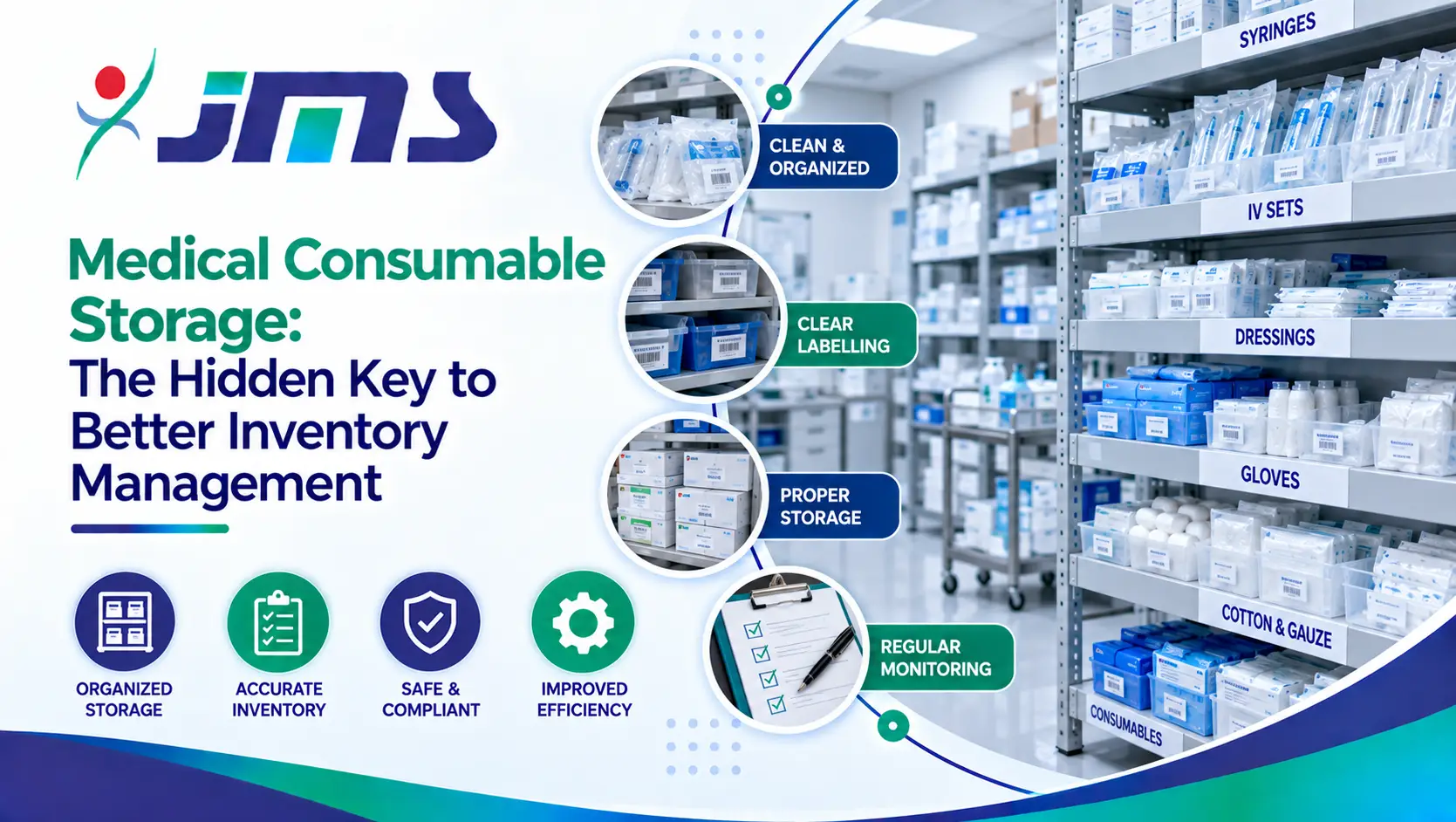
Medical Consumable Storage

Medical Consumable Storage: The Hidden Key to Better Inventory Management

Medical consumables are an essential part of everyday healthcare operations. Hospitals, clinics, nursing homes, diagnostic centres, pharmacies, and other healthcare facilities depend on products such as gloves, cotton, gauze, dressings, medical tapes, orthopedic products, and other healthcare supplies. However, purchasing quality medical products is only one part of maintaining their usability. Proper storage is equally important. Poor storage conditions can expose products to moisture, dust, excessive heat, physical damage, contamination, or packaging deterioration. A well-planned storage system helps healthcare facilities protect their inventory, monitor expiry dates, maintain product organization, and ensure that supplies are available when needed. Why Proper Storage of Medical Consumables Matters Medical consumables are often used directly in patient care and clinical procedures. Their condition can therefore matter to healthcare professionals and patients. Proper storage can help healthcare facilities: Protect products from environmental damage Maintain packaging integrity Reduce unnecessary product wastage Improve inventory management Make expiry monitoring easier Reduce the risk of using damaged or expired products Improve stock rotation Support efficient procurement and supply management Storage requirements can vary from one product to another, so healthcare facilities should always follow the manufacturer’s instructions and applicable facility procedures. General Best Practices for Storing Medical Consumables Before looking at individual product categories, healthcare facilities can follow several basic storage principles. 1. Keep Storage Areas Clean Medical consumables should be stored in clean and well-maintained areas. Storage rooms and shelves should be regularly cleaned and kept free from unnecessary dust, dirt, waste, chemicals, and other potential contaminants. Products should generally not be placed directly on the floor. Shelving can help protect packaging and make inventory easier to inspect. 2. Control Moisture and Humidity Moisture can damage certain medical products and their packaging. Damp environments may contribute to packaging deterioration and may increase contamination concerns. Storage areas should therefore be kept dry and adequately ventilated. Healthcare facilities should also protect products from: Water leaks Condensation Damp walls Wet floors Excessive humidity Where a product has specific humidity requirements, the manufacturer’s instructions should be followed. 3. Follow Manufacturer Temperature Instructions There is no universal storage temperature for every medical consumable. Different products may have different storage requirements. Therefore, healthcare facilities should check the product label, packaging, instructions, or manufacturer’s documentation before deciding where and how a product should be stored. Products should be protected from excessive heat, freezing conditions, direct sunlight, or temperature fluctuations whenever the manufacturer specifies such precautions. 4. Protect Original Packaging Original packaging can help protect medical products from dust, moisture, light, contamination, and physical damage. Whenever appropriate, products should remain in their original packaging until they are required for use. Staff should regularly check packaging for: Tears Punctures Broken seals Water damage Crushing Fading or unreadable labels Products with compromised packaging should be handled according to the healthcare facility’s established quality and safety procedures. Storage Best Practices for Different Medical Product Categories Different medical consumables have different characteristics. Storage practices should therefore be considered according to the product category. 1. Medical Gloves Medical gloves are widely used in hospitals, clinics, laboratories, diagnostic centres, and other healthcare environments. They should be protected from environmental conditions that could affect the packaging or material. Storage Best Practice for Medical Gloves Store gloves in a clean and dry area. Keep them away from direct sunlight. Protect them from excessive heat. Avoid unnecessary exposure to moisture. Keep the original packaging intact until use. Do not place glove boxes directly on the floor. Avoid storing them near chemicals or other materials that could damage the packaging. Check expiry dates regularly. Gloves should be stored according to the manufacturer’s recommended conditions and product labeling. 2. Cotton Products Medical cotton products may be used for cleaning, wound care, dressing, and other healthcare applications. Examples can include absorbent cotton, cotton rolls, cotton balls, zig-zag cotton, and other specialized cotton products. Storage Best Practice for Cotton Products Store cotton products in a clean, dry environment. Protect them from moisture and water. Keep packaging intact. Avoid exposure to dust and other contaminants. Keep products away from chemicals and strong odors. Store products on clean shelves rather than directly on the floor. Monitor expiry or shelf-life information where applicable. Moisture control is particularly important because damp conditions can compromise packaging and product condition. 3. Gauze and Wound-Care Products Gauze, dressings, and other wound-care materials are commonly used for wound management, cleaning, dressing, and clinical procedures. For products supplied as sterile, maintaining package integrity is particularly important. Storage Best Practice for Gauze and Dressings Store products in a clean and dry area. Protect sterile packaging from moisture and physical damage. Avoid crushing, tearing, or puncturing packages. Keep sterile products in their original packaging. Do not use products if sterile packaging is visibly compromised. Organize products by type and size for easy identification. Check expiry dates and batch/lot information regularly. Sterile products should be handled according to the manufacturer’s instructions and the healthcare facility’s infection-control procedures. 4. Medical Tapes Medical tapes may be used for dressing fixation, IV-site support, cannula fixation, and other healthcare applications. Their adhesive properties and packaging can be affected by unsuitable environmental conditions. Storage Best Practice for Medical Tapes Store tapes in a clean and dry area. Follow the manufacturer’s specified temperature conditions. Protect products from excessive heat. Avoid unnecessary exposure to moisture. Keep packaging closed or intact until use. Protect rolls from dust and physical damage. Rotate stock according to expiry or shelf-life information. Always check the manufacturer’s instructions for product-specific storage conditions. 5. Orthopedic Products Orthopedic supplies can include products used for support, immobilization, dressing, casting, and related clinical applications. Different orthopedic products may have different storage requirements. Storage Best Practice for Orthopedic Products Keep products in clean, dry storage areas. Organize products by type and size. Avoid excessive pressure or stacking that could damage packaging. Protect products from moisture. Keep them away from direct sunlight and excessive heat where applicable. Maintain clear product identification. Check packaging condition before use. Monitor expiry or shelf-life information where applicable. Products such as casting and dressing materials

Medical Consumable Storage: The Hidden Key to Better Inventory Management Read More »